


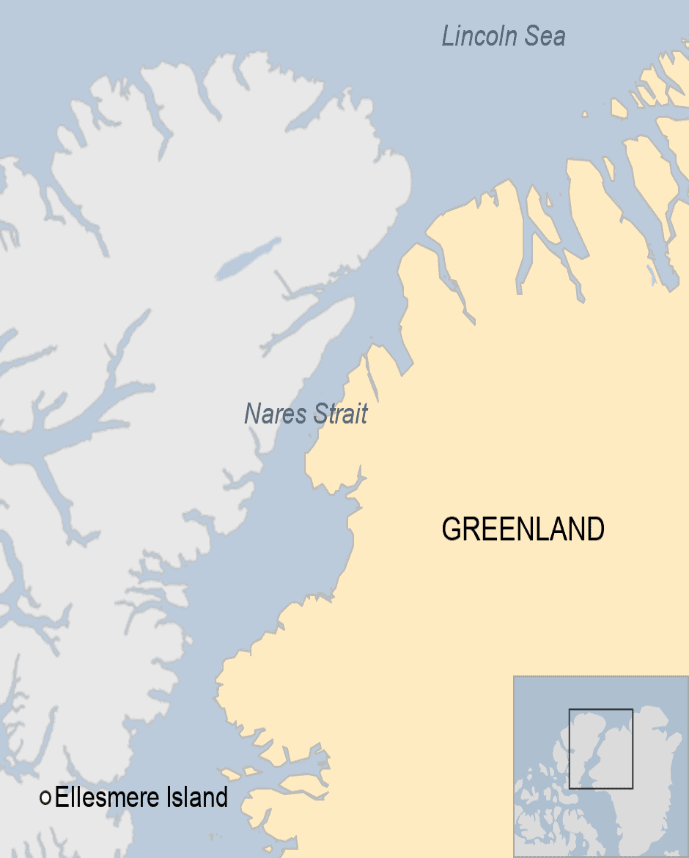
An island (a small rock) exactly 18 km away from Canada and Denmark’s respective borders in Nares Strait has been in dispute since 1973.
The old mental model viewed oceans as barriers and often protection for coastal nations.
Certainly the English Channel has been used as a moat and protection for England as long as there’s been recorded history of invading raiding party’s.
But today the new mental model views these bodies of water as high-speed highways.
Climate change is contributing to opening the Arctic. It will become very attractive for nations to use these northern routes rather than the Panama Canal.
For example: The size of the container ships can be much larger than currently restricted by the Panama Canal and/or Suez Canal. Using the traditional routes from China it takes 30 to 48 days. Using Russia’s northern route the time is cut by one third. A significant saving in time, labour and fuel costs.
Hence control is coveted as these highways provide disruptive efficiencies for nation’s supply chains. Certainly China as a global manufacturing centre increasingly exploits and attempts to exercise more control over these body of waters. The East and South China Sea are two examples how aggressively a nation can become to gain control. The Arctic northern waterways between China and Europe are prime targets and Canada Northwest Passage is in the cross hairs.
There are three artic routes primary located between the norther borders of Canada and Russia.
Russia has exercised strong control over its northern route – Northeast Passage. This is evidenced by 41 Russian icebreakers with 4 more under construction to include a Sevmorputcontainer carrier. Russian nuclear icebreakers control their passage and escorts nations shipping transit through their passageway. The Russians have established military bases in the high north — one within 600 miles of the North Pole…
The centre passage is not passable due to ice.
The Northwest Passage (the third) is claimed by Canada as a Canadian ‘internal waterway’- Canadian Territory! With climate change incrementally this waterway is opening.
China and The United states say no— not Canada’s. .. At best, it is an international strait. In essence minimizing Canada’s sovereignty over this territory.
It remains in dispute. Canada has little capacity to exercise control over these lands. Argggg.
The question becomes… given Canada has the second largest landmass in the world, with what Michael Porter would describes as “rich” with basic factor endowments (minerals, rare earths, oil and gas, wood and 20% of the world’s freshwater going to retain Canada’s sovereignty with less than 40 million people? A very rich jewel desired by nations.
The news daily foreshadows that nations with power rationalize quickly why they are justified in aggressive implement regime change in smaller nations (Iraq (global vehicle currency threatened), Libya (global vehicle currency threatened), Kuwait, Taiwan, Uyghurs ‘home’ province of Xinjiang (Pipe line/ Muslims catalyst), Tibet Plateau, Crimea, Ukraine) all invaded for the factor endowments like oil, gas, water and access to superhighways.
Indeed Canada has been the object of such activity. In the 1965 bestseller, “Lament for a Nation: The Defeat of Canadian Nationalism by George Grant (1) Lament for a nation – Search (bing.com) (I still have my copy) will be enlightening for younger Canadians.
Grant from the University of Toronto sets out the evidence of the political fate of our Prime Minister John Diefenbaker once he refused to allow nuclear arms on Canadian soil. Significant resources are put in motion by the Kennedy administration support Canada’s opposition party.
The Americans were successful. The Liberal party of Canada formed the government and in very short order accepted the American warheads.
At hockey games we sing… we stand on guard… But do we?
One solution regarding Canada’s sovereignty I touched upon in my book is it possibly time for Canada to consider becoming a junior partner and move towards political union with a major power– one of our neighbours. America, China, Russia or even resurrect the power of the British Commonwealth community of nations. Undertake an honest business case analysis as to what would be in Canada’s best interest in the decades ahead. It is a discussion I feel Canadians must have OR continue sleepwalking into such an event taking place — the difference that we will not participated in the process.
This article was a small amicable agreement where both sides agreed to share sovereignty with the other neighbour. Truly Canadian. If you have time to take a moment and scan…
You can read more on this topic …. Canada’s Arctic Sovereignty: Under Attack (Canadian – American Interdependence: Under Attack Book 1) eBook : Power, Terrance, Power, Pauline: Amazon.ca: Books
Canada and Denmark reach deal to divide uninhabited Arctic island
By Ashley Burke
Canada and Denmark have reached an agreement to divide a tiny uninhabited island in the Arctic, ending a nearly 50-year-long international dispute between two friendly countries.
The Canadian government posted an order-in-council this week confirming the Hans Island deal. The government plans to announce the details Tuesday.
Martin Breum, a Copenhagen journalist and expert on the Arctic, said he’s been briefed by government officials in Denmark on parts of the deal. He said the settlement shows the two countries agreed to split the 1.3-square-kilometre rock almost down the middle.
A border separating the countries will follow a rift in the island that stretches from north to south, said Breum.
“It’s not exactly a 50/50 share,” he said. “They’re sharing the island in two halves. One will be Canadian, the other will be part of Greenland which is part of the Danish kingdom.
“It’s a matter of a few percentages and the Greenland part will be slightly bigger than the Canadian.”
The Canadian government is expected on Tuesday to present the deal — first reported by the Globe and Mail — as an example of how countries can resolve international disputes peacefully under the rules-based international order. The move comes as NATO allies have joined together in a united front against the Russian invasion in Ukraine.
Breum said that while both governments will say it’s a “fabulous deal,” it’s taken a “really long time to resolve a very, very small issue.”
“This is an example of how even the smallest piece of territory can excite governments to a point where even allies disagree for decades,” he said.
The dispute over Hans Island dates back to 1973, when Canada and Denmark tried to establish a border through the Nares Strait waterway.
Hans Island shoots up vertically 180 meters from the icy waters between Canada and Greenland. Both countries are exactly 18 kilometres away from the island, allowing them to claim the rock under international law.
Breum visited the island by helicopter in 2018 and describes it as a “beautiful,” desolate piece of history. He said the only artifacts there are the remnants of Canadian and Danish flags and placards staking their claims over the years.
“You actually feel history right there,” said Breum. “You feel the closeness of both nations. And then knowing that you are on top of the 50-year-old conflict of international magnitude is really odd because there’s nothing there.
“It’s worthless. There’s no minerals, there is no oil in the waters next to it.”
Some international media outlets have nicknamed the dispute the “whisky war” or the most “polite” of all territorial conflicts.
The New York Times said that while other international disputes “can be ugly affairs, waged with all the nastiness of a divorce, backed with the forces of armies,” the disagreement between Canada and Denmark would “better suit a dinner party than a battlefield: it comes down to B.Y.O.B.”
Military ships visiting the island in the 1980s planted flags and bottles of Canadian whiskey or Danish schnapps to stake their claims. That suddenly stopped when both countries decided they needed to work out their differences as allies, said Breum.

© Polfoto/The Associated PressThe crew of the Danish warship Vedderen perform a flag raising ceremony on uninhabitated Hans Island in August 2002.
There wasn’t significant movement on the file until 2018, when a multinational task force took up the matter, said Breum.
Michael Byers, a political science professor at the University of British Columbia, has been calling for a peaceful resolution to the dispute for decades. He said Russian President Vladimir Putin’s invasion of Ukraine created the “right moment” for the countries to finally resolve the issue once and for all.
It’s all about the symbolism
“There’s no significance of the border, except the signal it sends to the world that we can resolve our disputes in a friendly way,” said Byers.
Byers says the two countries decided to draw a line along a geological feature that can be seen on satellite images. He said border guards will not be present because it’s the symbolism that matters to the two nations.
“It’s a novelty,” he said. “It’s possible this will become a tourist destination.”
Greenland’s Inuit have long used Hans Island as a staging point when hunting in the area, according to media reports.
Nunavut Tunngavik Incorporated (NTI) is the legal representative of the Inuit of Nunavut for the purposes of native treaty rights and treaty negotiation.
The organization’s president, Aluki Kotierk, said “Canada’s sovereignty in the Arctic is only possible because of Inuit use and occupancy.”
“The dispute between Canada and Denmark over Tartupaluk or Hans Island has never caused issues for Inuit,” said Kotierk in a media statement. “Regardless, it is great to see Canada and Denmark taking measures to resolve this boundary dispute.”
Global Affairs Canada said that, due to a media embargo in place until tomorrow’s event, it is “politely declining” CBC’s request for a comment about the settlement.
Russia has planted flags staking claims to the Arctic region. A mini submarine dropped a titanium capsule containing a Russian flag onto the ocean floor beneath the North Pole in 2007 in an attempt to stake a claim to the region’s oil and minerals.
